Table 1 summarizes the main differences from prior work. Depth Under Visual Degradation. Thermal cameras [41] and multi-echo LiDAR [38] extend optical-band sensing but remain attenuated by dense smoke [3] and provide no metric depth under uniform heating. Image restoration [10, 18, 31, 59] and diffusion inpainting [36, 44] require residual visual signal; they fail when the optical path is blocked. These approaches remain coupled to optical availability, the failure regime GRADE targets. Multi-Modal Radar Fusion. Camera-radar [33, 46, 50, 52] and radar-LiDAR/NIR stacks [22, 39, 57] compensate for radar sparsity by treating the optical sensor as the primary feature source. This assumption breaks under degradation:
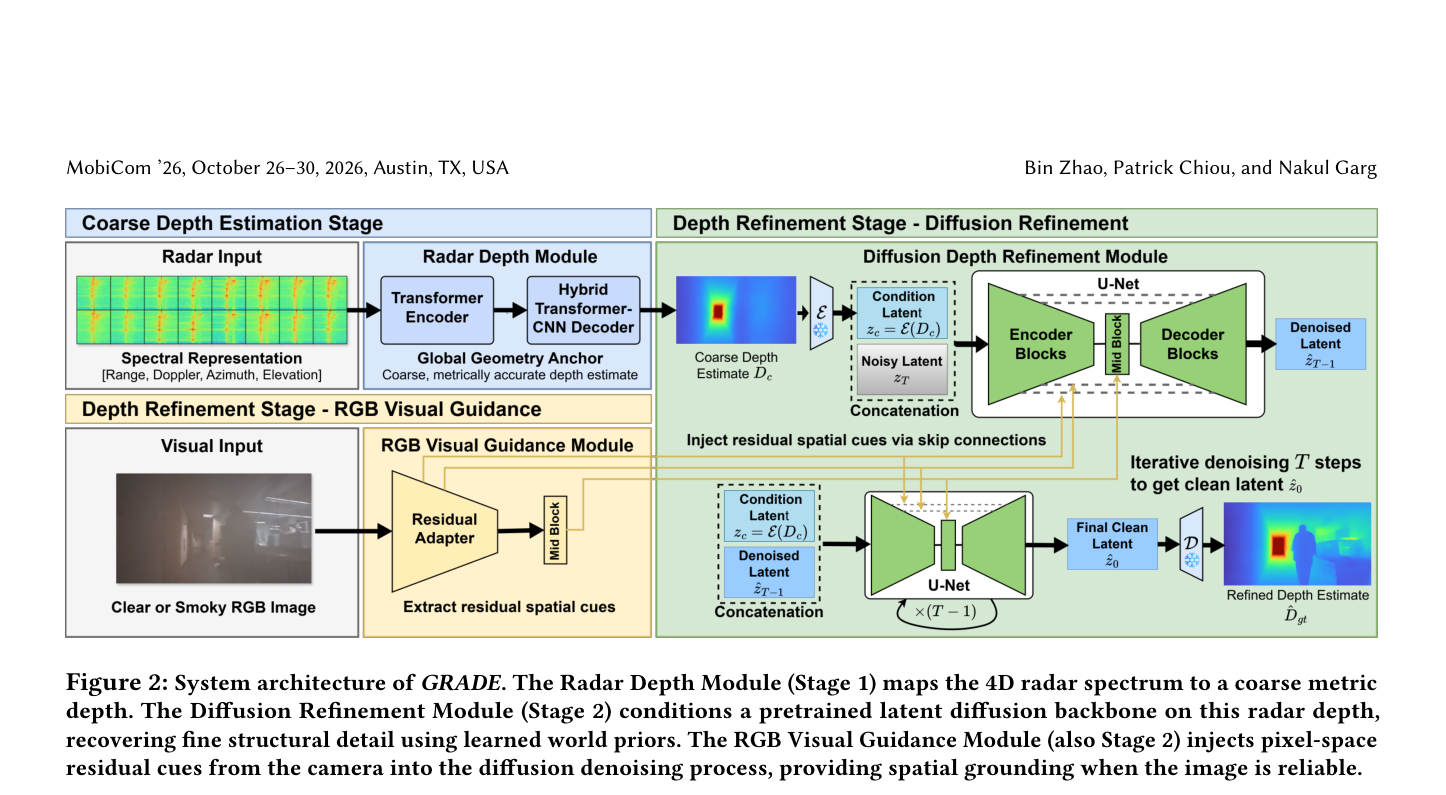
Figure 2: System architecture of GRADE. The Radar Depth Module (Stage 1) maps the 4D radar spectrum to a coarse metric depth. The Diffusion Refinement Module (Stage 2) conditions a pretrained latent diffusion backbone on this radar depth, recovering fine structural detail using learned world priors. The RGB Visual Guidance Module (also Stage 2) injects pixel-space residual cues from the camera into the diffusion denoising process, providing spatial grounding when the image is reliable.
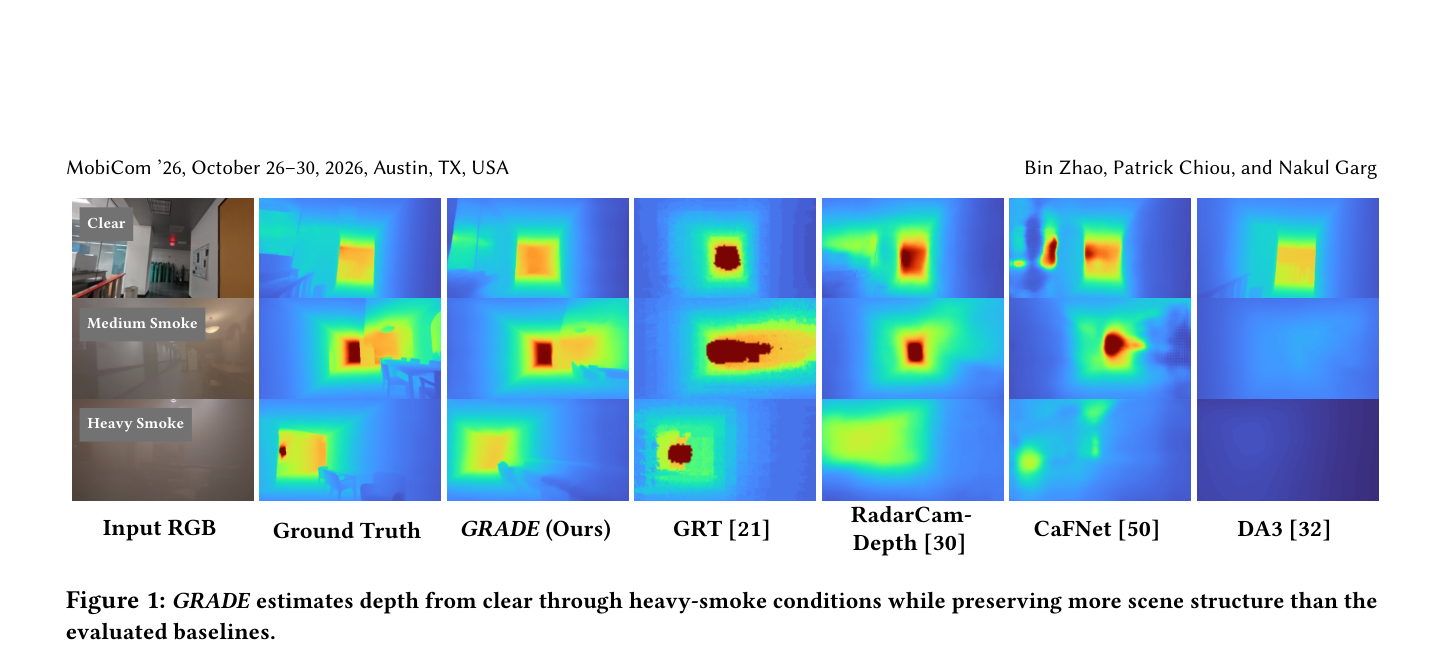
Table 3 separates the smoke results by the sensor thresh- olds defined above. DA3’s MAE rises from 0.548 m in light smoke to 1.751 m in heavy smoke, and its CD rises from 0.290 to 7.796 m2. CaFNet shows the same directional trend: its CD rises from 0.278 to 3.503 m2. The clear-only CaFNet variant reaches 3.164 m2 under heavy smoke, so smoke train- ing does not provide a consistent advantage across these strata. RadarCam-Depth degrades more gradually, with CD increasing from 0.332 to 0.703 m2. The raw-radar methods change much less with smoke. GRT’s MAE varies from 0.442 to 0.404 m and GRT+Image from 0.415 to 0.404 m. GRADE changes from 0.295 to 0.304 m MAE and from 0.122 to 0.129 LPIPS between light and heavy smoke. In the heavy stratum, its CD is 0.104 m2, compared with 0.137 m2 for GRT+Image and 0.173 m2 for GRT.
该表按烟雾密度分层展示了各方法的性能。重点观察 GRADE 在重度烟雾下的 CD 值,其稳定性远超相机依赖的基线方法,验证了雷达几何基础的重要性。