快速导读:本文提出 DIAL 框架,通过挖掘 DiT 中的 Intrinsic Spatial Grounding Map (ISGM),在低噪声阶段实现免训练的可控保真度引导,在高噪声阶段通过零成本偏好优化锚定主体语义,显著提升了多主体视频生成的身份一致性与稳定性。
多主体视频生成(S2V)面临保真度不可控与语义漂移两大挑战。现有方法往往在“复制粘贴”的生硬效果与主体随时间消失之间难以平衡。
本文提出 DIAL 框架,通过挖掘 DiT 中的 Intrinsic Spatial Grounding Map (ISGM),在低噪声阶段实现免训练引导,在高噪声阶段通过零成本偏好优化锚定语义,显著提升了生成质量。
英文题目:Harnessing Intrinsic Subject-Aware Attention for Controllable Multi-Subject Video Generation
论文出处:arXiv 每日论文精选 · arXiv:2609.11507
原始论文:PDF / 论文页面
这篇论文解决什么问题?
基于 Diffusion Transformer (DiT) 的视频生成模型在 T2V 和 I2V 任务上表现优异,但在需要严格保持多个个性化主体视觉一致性的 S2V 任务中表现不佳。
现有方法多依赖高质量数据筛选、VLM 特征提取或特定架构(如 R-RoPE),但缺乏对注意力机制内部机理的深入利用,导致无法在推理时动态调整一致性强度。
语义漂移表现为主体随时间消失、属性错误(如颜色漂移)或多参考图身份纠缠,严重影响了生成视频的可用性。
核心创新
- 发现并定义了 Intrinsic Spatial Grounding Map (ISGM),揭示了 DiT 中特定注意力块能精准定位参考主体的内在机制。
- 提出免训练的推理时注意力引导机制(Phase I),支持多主体独立、连续且精细的保真度强度控制,无需模型更新。
- 引入零成本偏好对构建策略(Phase II),利用 ISGM 与掩码的对齐度自动评估去噪轨迹,通过 RL/DPO 在高噪声阶段锚定主体语义。
- 在 OpenS2V-Eval 基准上达到 SOTA 性能,同时保持视频自然度,显著降低语义漂移。
方法概览
DIAL (Dual-phase Intrinsic Attention Leveraging) 包含两个阶段:
1. Phase I (低噪声推理引导):识别 DiT 中特定注意力块形成的 ISGM(内在空间定位图)。在去噪后期(约后80%步骤),利用前一步的 ISGM 构建注意力偏置矩阵,注入到所有自注意力模块中。通过调节每个主体的保真度尺度 γk,实现免训练、区域自适应的身份保真度控制。
2. Phase II (高噪声偏好优化):在高噪声阶段(约前20%步骤),ISGM 信号噪声大且不可靠。利用 ISGM 与真实主体掩码的空间对齐程度自动构建偏好对(Preference Pairs),无需人工标注。采用多步 DPO (Direct Preference Optimization) 训练模型,锚定主体语义,缓解语义漂移。
- Phase I (低噪声推理引导):识别 DiT 中特定注意力块形成的 ISGM。在去噪后期(约后80%步骤),利用前一步的 ISGM 构建注意力偏置矩阵,注入到所有自注意力模块中。
- 通过调节每个主体的保真度尺度 γk,实现免训练、区域自适应的身份保真度控制,无需模型更新。
- Phase II (高噪声偏好优化):在高噪声阶段(约前20%步骤),ISGM 信号噪声大且不可靠。利用 ISGM 与真实主体掩码的空间对齐程度自动构建偏好对(Preference Pairs),无需人工标注。
- 采用多步 DPO (Direct Preference Optimization) 训练模型,锚定主体语义,缓解语义漂移。
- ISGM 的提取依赖于预识别的特定注意力块,不同模型或任务可能需要重新分析定位该块。
逐图理解论文
失败案例
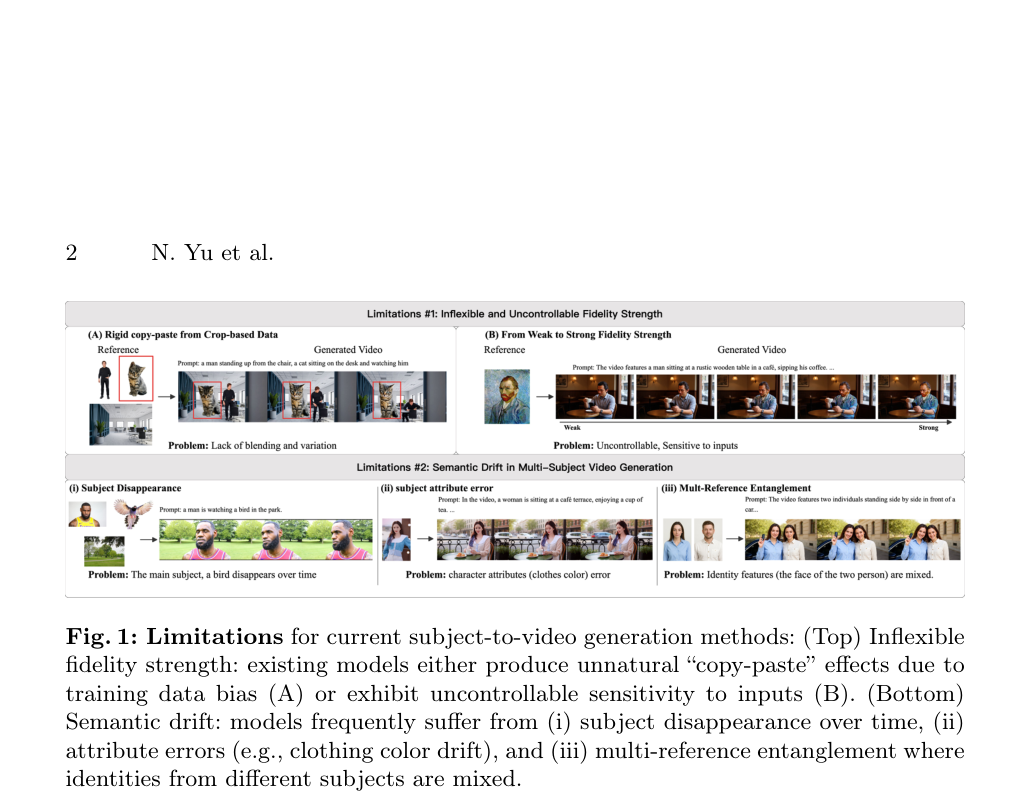
展示现有 S2V 方法的局限:保真度不可控和语义漂移。
研究缺口
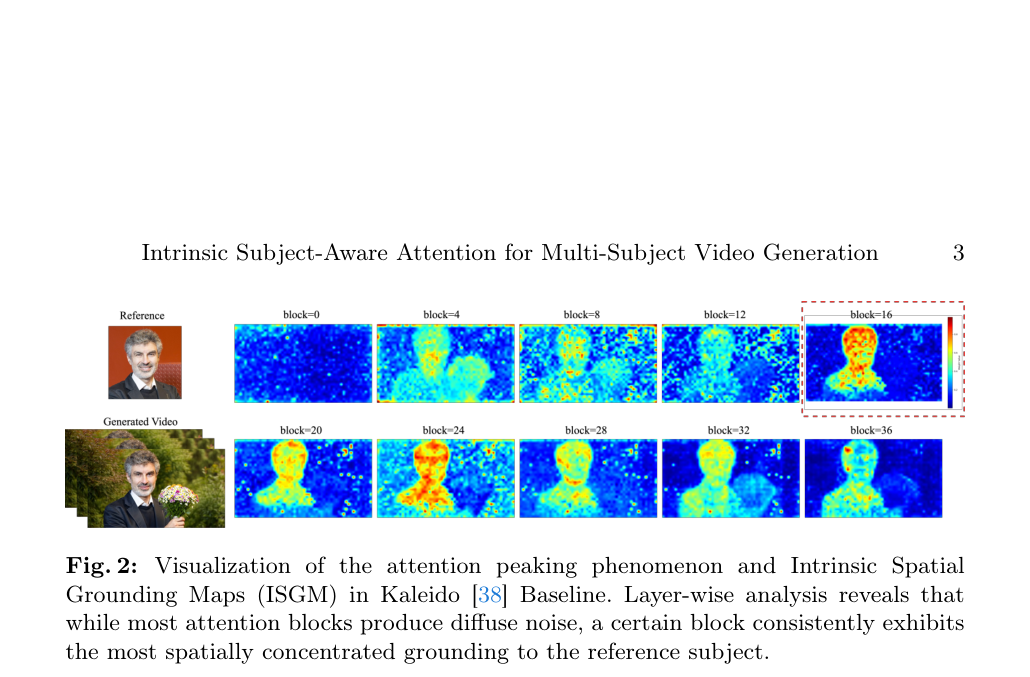
可视化 ISGM 在 Kaleido 中的注意力峰值现象。
DIAL 框架
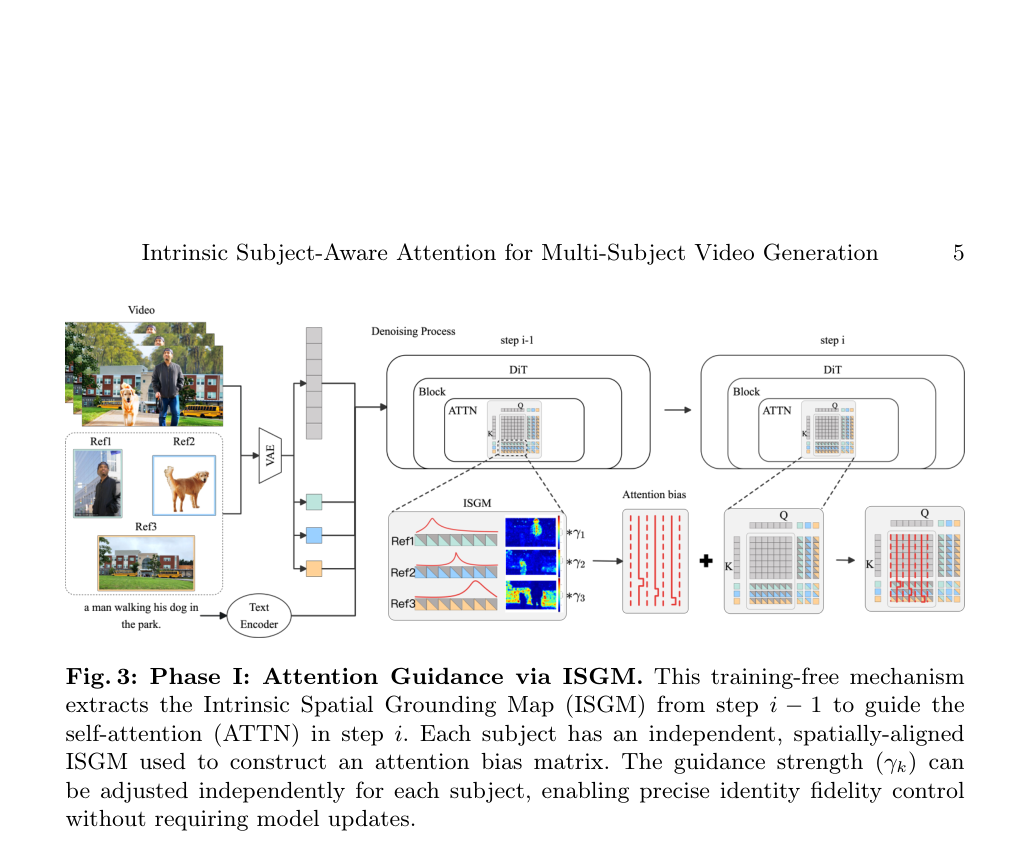
展示 Phase I 中 ISGM 如何引导自注意力。
实验验证
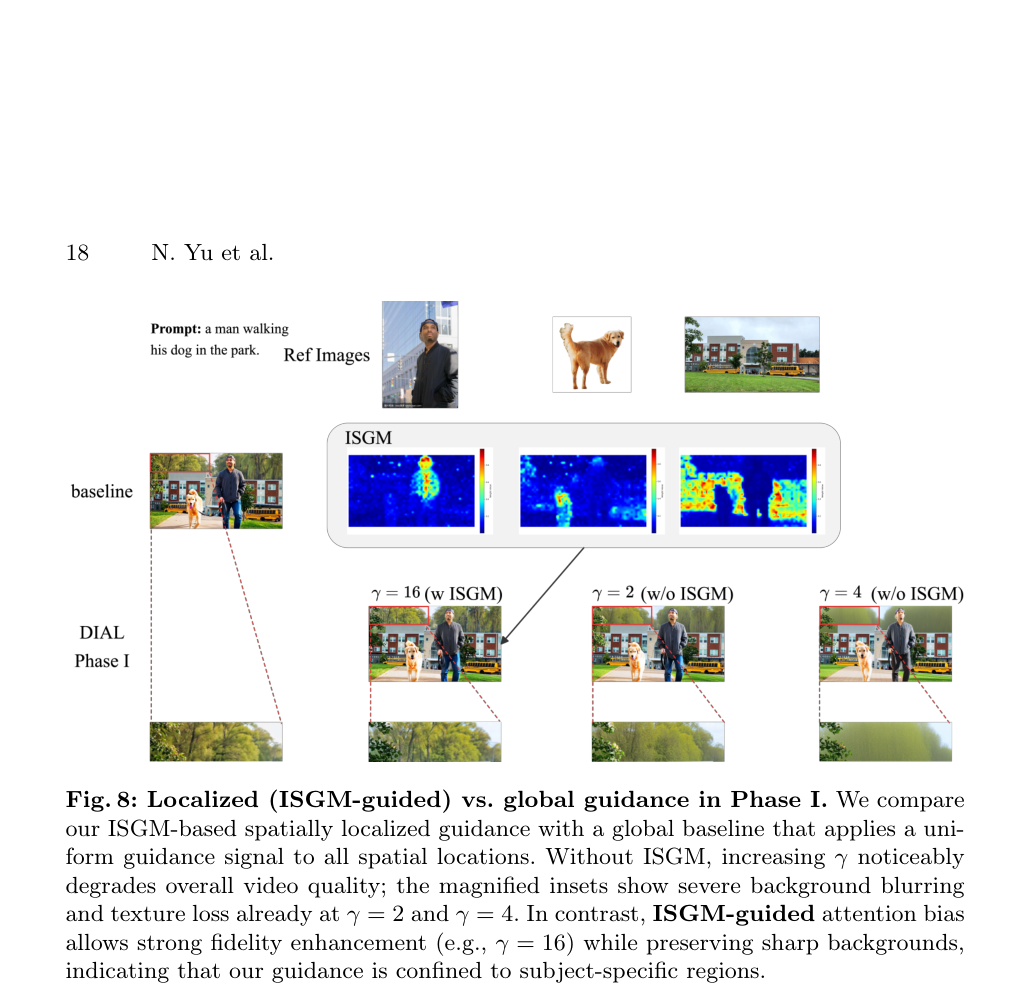
对比 ISGM 引导与全局引导在背景保持上的差异。
结论与局限
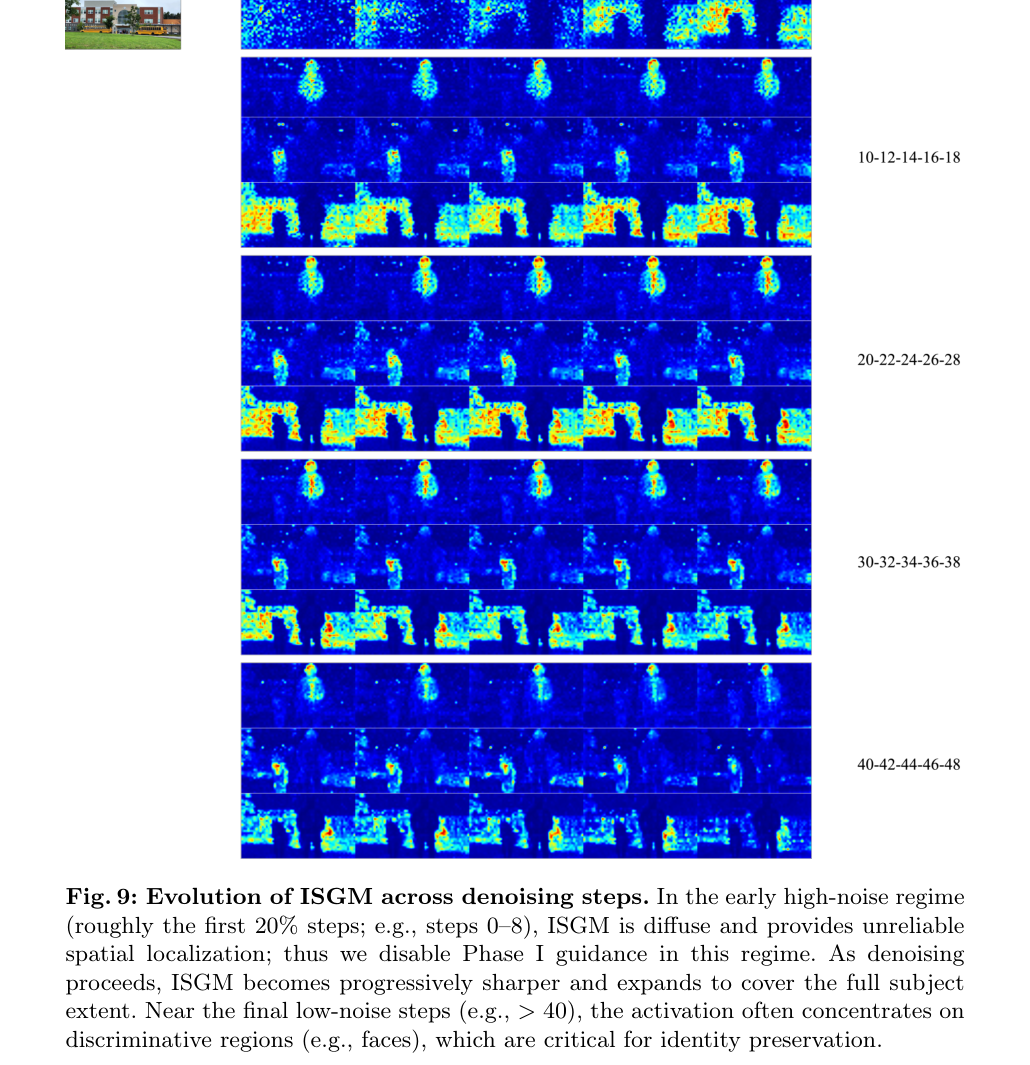
展示 ISGM 随去噪步骤的演化,高噪声阶段不可靠。
实验如何设计?
- 在 OpenS2V-Eval 基准上评估,涵盖单主体、多主体及人机交互场景。
- 基线模型:Phantom-14B 和 Kaleido-14B(基于 Wan2.1-T2V-14B)。
- 对比方法:MAGREF, VACE, SkyReels-A2, BindWeave, SkyReels-v3 等。
- 消融实验:验证 ISGM 与全局均匀引导(Uni)的效果差异,以及 DPO 迭代次数 (Tdpo) 的影响。
关键结果与论文证据
- Kaleido + DIAL (γ=8) FaceSim: 57.46% (vs. Baseline 31.81%) (p.12)
- ISGM (γ=16) NaturalScore: 75.23% (vs. Uni (γ=2) 69.03%) (p.13)
- Phase II Subject Presence Ratio: 0.51 (vs. Kaleido Baseline 0.48) (p.19)
- ISGM 引导在强保真度下保持背景清晰,而全局引导导致背景模糊 (p.18)
阅读时需要注意
- Phase I 引导仅适用于低噪声阶段,高噪声阶段 ISGM 信号扩散且不可靠。
- Phase II 训练依赖 Phantom-Data 数据集,训练数据背景风格有限。
- ISGM 的提取依赖于预识别的特定注意力块,不同模型可能需要重新分析。
关联工作
- Kaleido 和 Phantom 作为基线骨干,分别使用 R-RoPE 和跨模态对齐。
- Diffusion-DPO 是 RL 方法,DIAL 使用零成本偏好构建替代人类反馈。
- DiTCtrl 关注 MM-DiT 中的注意力控制,DIAL 识别特定 ISGM 块。