快速导读:OPERA 用单一 MLLM 做双轴渐进推理:时序粗到细选关键帧,空间先蒸馏“找什么”再用 GRPO 定位,最后传播掩码。
指代视频分割一旦查询混入文本、语音、环境声与参考图,模型既要跨模态对齐语义,又要在遮挡、运动模糊帧上稳住时空定位。两步串行 LLM 调用若关键帧选错,错误会直接传播进掩码。
OPERA(arXiv:2609.33338 ,清华 / UCSD / ETH)用单一 MLLM 做成统一代理:时间轴粗到细筛关键帧,空间轴先蒸馏“找什么”再用 GRPO 强化的思维链定位“在哪”,最后把框交给掩码传播模块得到逐帧分割。
英文题目:OPERA: A Unified Omnimodal Progressive Spatio-Temporal Reasoning Agent for Referring Video Segmentation
论文出处:arXiv 每日论文精选 · arXiv:2609.33338
原始论文:PDF / 论文页面
这篇论文解决什么问题?
如图 1 所示:查询要找“外形像参考图、叫声像犬吠”的目标时,Omni-R1 在遮挡/模糊帧上两步串行定位失败,错误掩码随之扩散;OPERA 则沿 When/What/Where 三问渐进收窄。
任务空间含八种强制语言线索(文本或语音)与可选音/图补充的组合。若每套模态各做专用头,工程复杂且难迁移;若只靠一次全局推理,又容易在难帧上崩。
因此需要共享骨干、可覆盖全部组合,并把“推理协议”收益与骨干规模拆开验证的设计。
核心创新
- 双轴渐进推理:时间轴粗到细收窄帧空间,空间轴先语义蒸馏再定位。
- 单一 MLLM 覆盖八种模态组合,无需模态专用检测头。
- GRPO 强化的结构化定位输出,保证可解析框供掩码传播。
- OmniAVS/Ref-AVS 新 SOTA,并零样本迁移到标准指代视频分割基准。
方法概览
OPERA 在单一 MLLM 上实例化三阶段:Distillation Agent 把音/图等非文本线索蒸馏成统一文本提示 q′;Temporal Reasoning Agent 经均匀采样、视觉语言粗滤与 LLM 语义重排选关键帧;Grounding Agent 用 think+bbox 结构化输出,并以 GRPO(IoU 定位奖励+格式奖励)强化。关键帧框交给 SAM2 类模块双向传播得到逐帧掩码。
- Distillation Agent:把环境声、参考图等非文本线索写成简洁文本提示(如 siren blaring),语音则保留原始音频并以 ASR/提示作约束,得到统一指令 q′。
- Temporal Reasoning Agent:均匀采样 K 帧 → 视觉语言余弦相似度粗滤到短名单 Nc → LLM 语义重排选出单一关键帧;消融显示 K=16、Nc=4 较稳。
- Grounding Agent:在关键帧上输出 ⟨think⟩…⟨/think⟩ 与像素框列表;奖励 R=αR_IoU+(1−α)R_fmt,R_IoU 按 IoU≥0.5 的 F1,R_fmt 奖励完整思维块与可解析框。
- Dense Mask Propagation:以关键帧框初始化记忆库,向前后双向传播得到全视频逐帧掩码;推理主链路约 7.69 s/视频(不含共享 SAM2 传播)。
逐图理解论文
失败模式
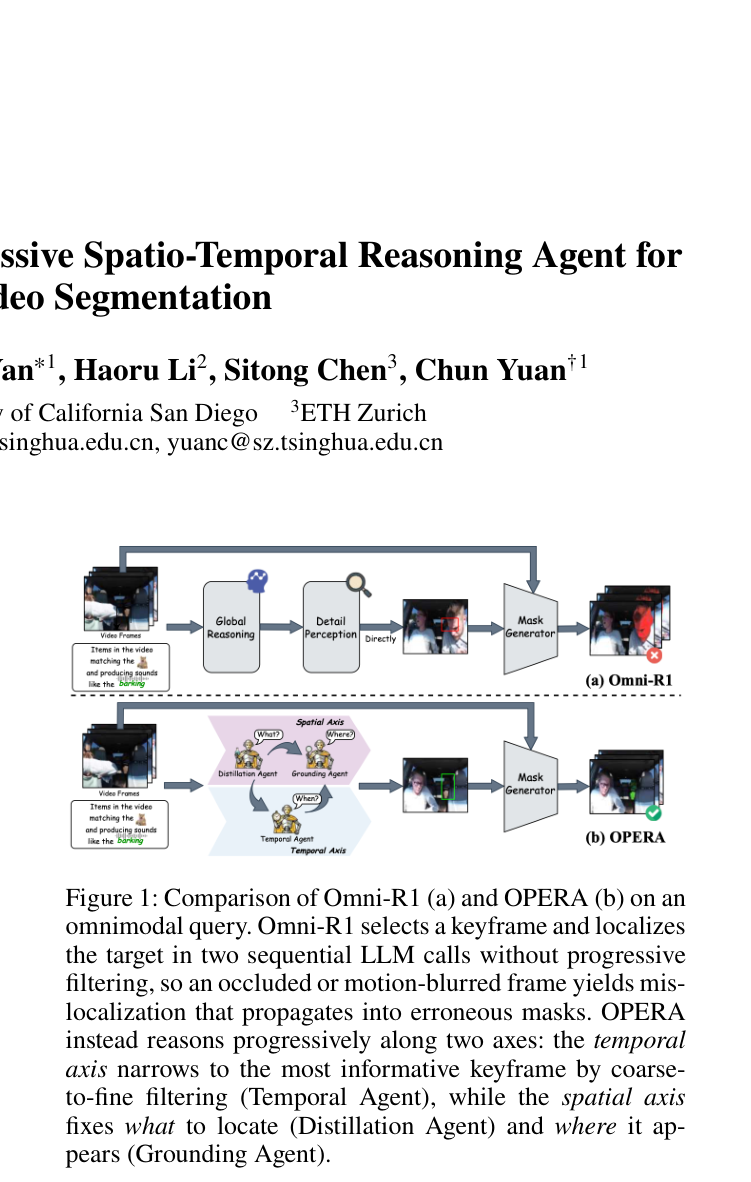
图1对比 Omni-R1 与 OPERA:前者两步串行在遮挡帧失败,后者用 Temporal/Distillation/Grounding 三代理渐进推理并正确掩码犬类目标。适合开篇讲动机。
双轴协议
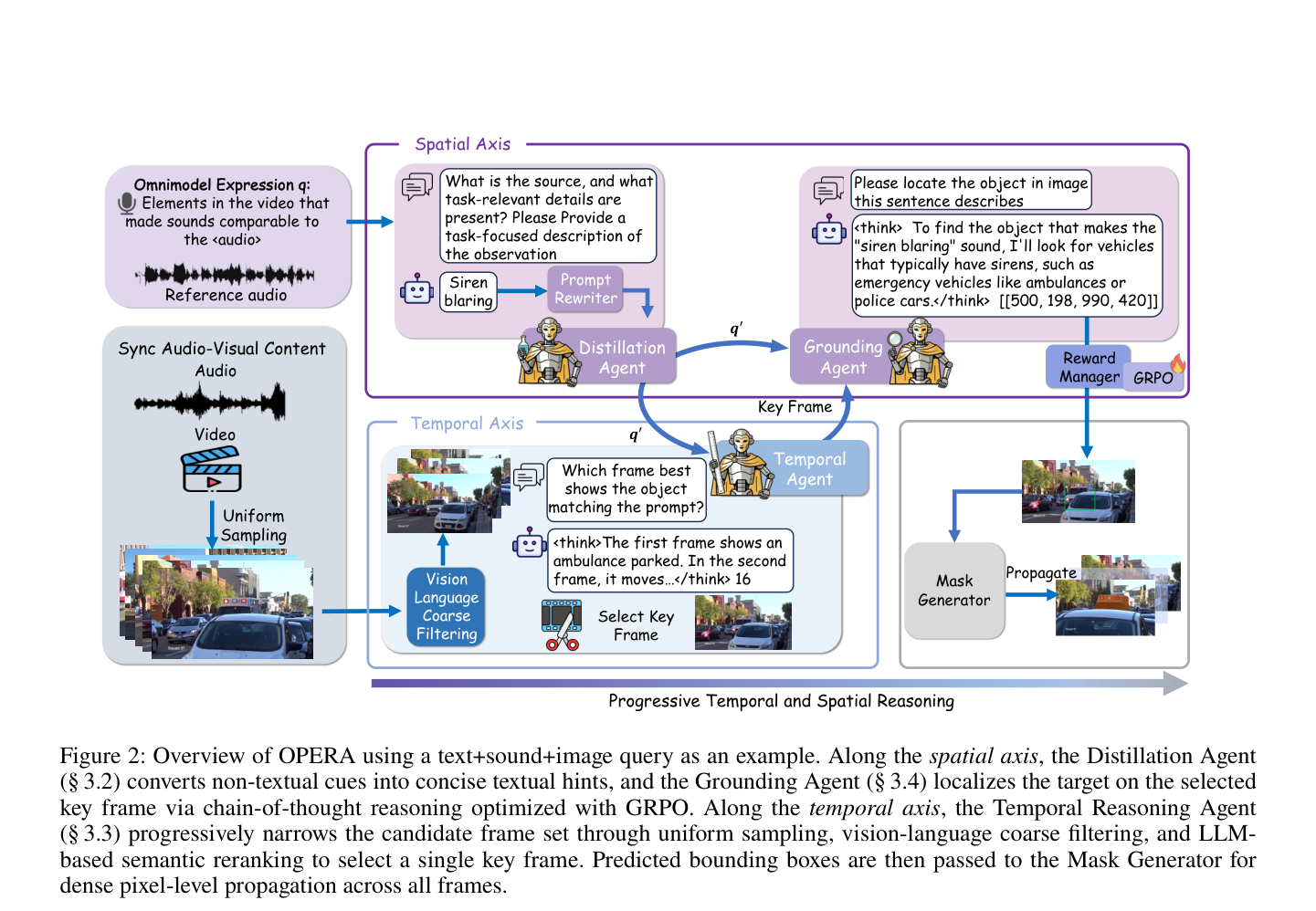
图2是方法主图:空间轴蒸馏+GRPO 定位,时间轴均匀采样→粗滤→语义重排选关键帧,再经 Mask Generator 传播。宜作特色图。
Figure 4: Qualitative results of OPERA on four examples spanning diverse query modalities
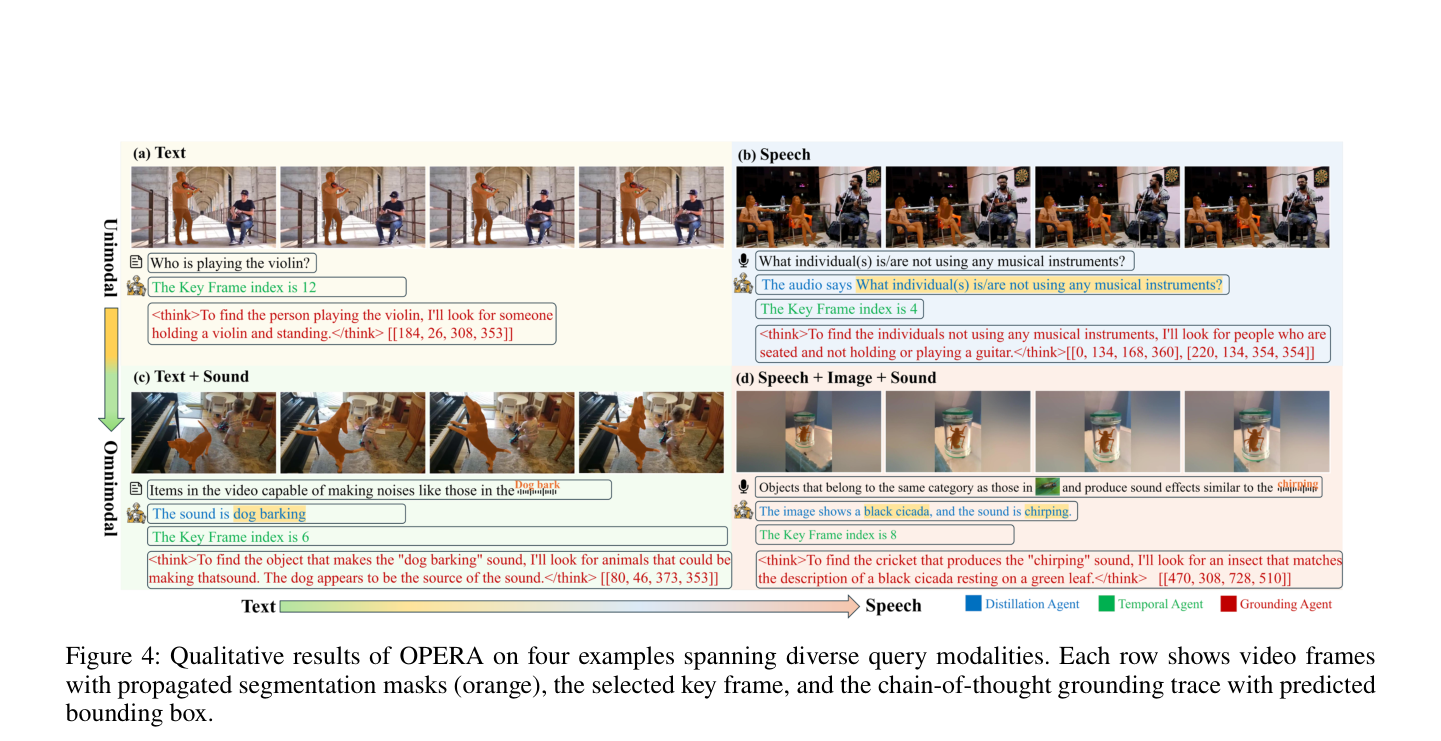
图4给出多模态查询定性案例:选中关键帧、思维链定位轨迹与橙色传播掩码,直观展示协议如何落到像素输出。
实验如何设计?
- 主基准 OmniAVS:八模态加权 All J&F,并按 Split I–VIII 分报。
- Ref-AVS:Seen/Unseen 的 J、F、J&F,检验新模态组合泛化。
- 额外零样本报告 R-YTVOS、R-DAVIS17、ReVOS(与域内微调方法分组不同)。
- 消融覆盖 TRA/DA/GA 开关、时序漏斗层级、蒸馏去掉 speech/sound/image、GRPO 奖励项,以及外部关键帧选择器对照。
关键结果与论文证据
- OmniAVS:OPERA-7B All J&F=53.3,相对 OISA +12.2、相对 Omni-R1-7B +6.7;较小的 OPERA-3B 也以 43.7 超过 OISA 的 41.1(页4,表1)。
- 音频主导 Split III/V/VI 提升约 26.9/23.8/24.9 点,直接支持蒸馏代理对跨模态桥接的作用(页5)。
- Ref-AVS:Seen/Unseen 达 67.8/74.4,相对 OISA 约 +12.6/+12.7;Seen 相对 Omni-R1-7B 约 +20.6(页5,表2)。
- 组件消融:基线 37.9 → 加 GA 42.1 → 加 TRA 44.8 → 全系统 53.3;蒸馏贡献最大,时序漏斗逼近候选内 oracle 的 54.1(页6)。
- 无 GRPO 仅 37.9,仅 R_IoU 到 50.3,加上 R_fmt 到 53.3;bbox-only 变体 46.7,说明可解析结构化协议很关键(页7)。
阅读时需要注意
- 默认假设整段视频可用,流式在线关键帧漏斗仍属未来工作。
- 相对 Omni-R1 多约 2 s 推理时延,需在精度与延迟间权衡。
- 思维链文本未被直接监督,不宜把收益全部归因于“更长的自然语言推理”。
关联工作
- Omni-R1、OISA 代表全模态/MLLM 指代分割近期强基线。
- ReferFormer、MeViS、LISA、VISA 等覆盖文本指代与视频推理分割。
- OmniAVS 与 Ref-AVS 分别检验八模态组合与音视频泛化。